Connecticut's Quiet Revolutionaries.
On June 14, 1776, the Connecticut General Assembly met in Hartford and passed a resolution instructing its delegates in the Continental Congress to "propose to that respectable Body to declare the United American Colonies Free and Independent States." The vote was unanimous.
This was one week before New York, New Jersey, and Maryland would even authorize their delegates to consider the question. Connecticut, small, largely agricultural, known for its Puritan steadiness rather than its revolutionary flair, had made up its mind.
The Self-Governing Colony
To understand why Connecticut moved so fast, you have to understand how different it was from most of British America. Connecticut was a "charter colony." Its 1662 royal charter from King Charles II was so permissive, allowing the colonists to elect their own governor, make their own laws, and run their own courts, that it was essentially self-governing from the start.
The famous Charter Oak story captures the Connecticut mindset. In 1687, when King James II sent an agent to seize the charter and install royal rule, Connecticut colonists simply hid the document inside a hollow oak tree until the crisis passed. Connecticut had been defending its autonomy for almost a century by the time the Revolution started.
Under the 1662 charter, Connecticut's legislature did not answer to a royal governor. It answered to the people who elected it. So when independence came up, there was no royal machinery to push back against. Just a legislature doing what it had always done.
Roger Sherman and the Committee of Five
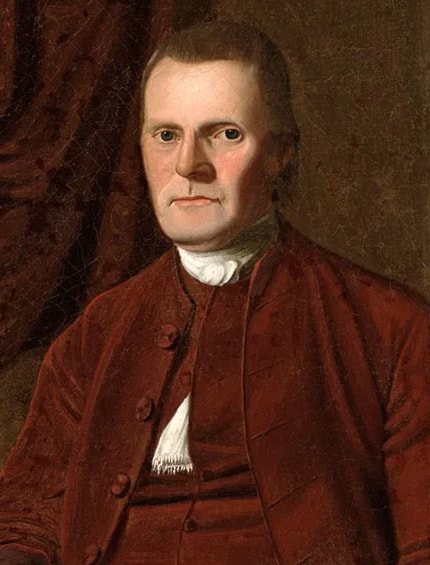
Connecticut sent an unusual delegation to the Continental Congress. The most consequential member was Roger Sherman of New Haven, a former shoemaker who had taught himself law, mathematics, and astronomy. He would go on to become the only person to sign all four of America's founding documents: the Continental Association, the Declaration of Independence, the Articles of Confederation, and the Constitution.
When Richard Henry Lee introduced his resolution for independence on June 7, 1776, and Congress appointed a committee on June 11 to draft a formal declaration, Sherman was named to that committee. He sat alongside Thomas Jefferson, John Adams, Benjamin Franklin, and Robert R. Livingston of New York. Five men charged with writing the document that would justify independence to the world.
Sherman was in Philadelphia doing that work during the exact week Connecticut's General Assembly was voting to authorize him. Connecticut was not simply going along with the crowd. It was helping write the very document that the crowd would sign.
Connecticut's War Had Already Started
By June 1776, Connecticut had been at war for over a year. The colony's militia had marched to Boston after Lexington and Concord. Connecticut troops had fought at Bunker Hill. Israel Putnam, the legendary commander who had reportedly ordered his men "don't fire till you see the whites of their eyes" at Bunker Hill, was a Connecticut farmer.
Connecticut was also doing something the other colonies couldn't. It was feeding the army. The colony's farms were so productive that Washington called Connecticut "the provision state," a nickname it still bears. The Continental Army's survival through 1776 and 1777 depended on what came out of Connecticut's fields and smokehouses.
By the time the General Assembly voted on June 14, the question was almost academic. Connecticut had already sent its men to the army and its harvest to feed them. The resolution just put the commitment in writing.
The Constitution State
Connecticut's official nickname today is the "Constitution State," a reference to its 1639 Fundamental Orders, one of the first written constitutions in the Western world. That founding document gave Connecticut a head start on self-government that would shape everything it did for the next 137 years.
When July 4, 1776 came, Connecticut was one of the colonies most prepared for independence. It had already been running itself. All that changed on July 4 was the name.
We commemorate Connecticut on our 50 State Heritage Collection ornament.