Delaware Separated From Two Countries on the Same Day.
On June 15, 1776, the Delaware Assembly met in the courthouse at New Castle and voted to do two things at once. It repealed all oaths of allegiance to King George III. And it dissolved its political union with Pennsylvania.
That second part is the one most people forget. Until that day, Delaware had not been a separate colony. It was the "Three Lower Counties" (New Castle, Kent, and Sussex) governed since 1682 by William Penn's Pennsylvania. They had their own Assembly but shared a governor with Pennsylvania. On June 15, 1776, with a single resolution, Delaware walked away from both the British crown and the Pennsylvania government. It became its own sovereign state.
The Three Lower Counties
Delaware's odd status dated back to a 1682 grant. William Penn, already proprietor of Pennsylvania, negotiated with the Duke of York, the future King James II, to acquire the land along the lower Delaware River. He did it because Pennsylvania had no ocean access. Without the Three Lower Counties, Pennsylvania's trade had to pass through territory that did not belong to it.
But the Lower Counties had been settled earlier by the Dutch and Swedes, and their population was different from Pennsylvania's. More Anglican, less Quaker, more tolerant of military force. By 1704, the friction was too much, and the Lower Counties were granted their own Assembly while keeping Penn's family as proprietor and sharing the same governor.
For seventy-two years, that arrangement held. Delaware had its own legislature but was, legally, an appendage of Pennsylvania. On June 15, 1776, that ended.
The Caesar Rodney Ride, Two Weeks Later
Delaware's most famous moment in the Revolution is not actually June 15. It is July 1-2, 1776, the night of Caesar Rodney's ride.
Rodney was one of Delaware's three delegates to the Continental Congress, along with Thomas McKean and George Read. By late June, McKean was firmly for independence and Read was firmly against. Rodney was the tiebreaker, and he was eighty miles away in Dover dealing with a Loyalist uprising in Sussex County.
On the evening of July 1, McKean sent an express rider south with an urgent message: the final vote on independence was tomorrow, and Delaware's vote would be split without Rodney. Rodney got the message that night. He mounted his horse, reportedly in his boots and spurs, with no change of clothes, and rode through a summer thunderstorm all night and into the morning of July 2.
He arrived at Independence Hall in Philadelphia muddy, soaked, and still booted. He cast Delaware's vote for independence, breaking the tie. The Continental Congress adopted the Lee Resolution that afternoon by a vote of twelve colonies to zero.
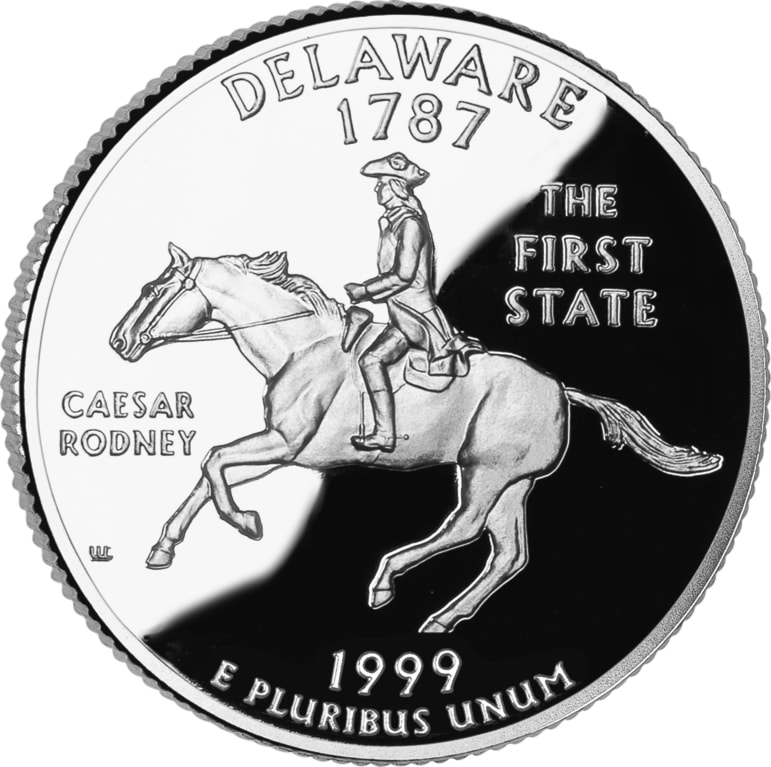
Rodney suffered from facial cancer and asthma, and no portrait of him was ever painted during his lifetime. He was self-conscious about his appearance. But today his image rides across the Delaware state quarter, hunched over his horse in the rain.
The First State
Delaware's official nickname is "The First State." The claim has nothing to do with June 15, 1776. It comes from December 7, 1787, when Delaware became the first of the thirteen states to ratify the United States Constitution. The vote was unanimous, 30 to 0.
But the path to being the first state was paved by that June 15 decision. Once Delaware separated from Pennsylvania, it was a free and distinct actor in the new American system. It didn't have to wait for Pennsylvania to finish debating. It could speak for itself.
And then it rode eighty miles through a thunderstorm to make sure its voice was heard.
We commemorate Delaware on our 50 State Heritage Collection ornament.