Why Is It Oval?
Of all the questions people ask about the White House, this one comes up more than almost any other. The President of the United States works in a room shaped like an egg. Why?
The answer starts not in Washington, D.C., but in Philadelphia, and not with a president but with a social ritual George Washington brought over from the courts of Europe.
Before moving into the President's House in Philadelphia in 1790, Washington ordered the straight rear walls of the building torn out and replaced with a curved, bow-window structure. He wanted a room where he could hold what were called "levees" — formal receptions where men of prominence would gather in a semicircle and the president would walk the room, addressing each guest by name before returning to his place. The oval shape was not decorative. It was functional. It created the perfect geometry for that kind of ceremony.
When architect James Hoban won the design competition for the White House in 1792, Washington's preference for oval rooms almost certainly influenced the plans. The Blue Room, the Yellow Oval Room, the Diplomatic Reception Room — they are all oval. That shape became woven into the identity of the building before a single president had slept there.
More than a century later, it would define the most famous office on earth.
Taft Builds the First One
For the first hundred-plus years of the White House's existence, there was no Oval Office. Presidents worked out of whatever rooms they could commandeer. Thomas Jefferson used a space that is now the State Dining Room. Most others set up shop on the second floor of the residence, in what is today known as the Lincoln Bedroom — which Lincoln himself used as an office, not a bedroom.
Theodore Roosevelt changed that in 1902 when he built the West Wing as a temporary workspace to get his staff out of the residence. But it was his successor, William Howard Taft, who made the West Wing permanent and commissioned the first oval-shaped presidential office in 1909.
Taft hired architect Nathan C. Wyeth, who modeled the new office after the White House's Blue Room. Wyeth wanted a space that conveyed, in his own words, "a dignified treatment in keeping with the high purpose it is to serve." The result was a room with three tall windows, a white marble fireplace mantel, Georgian Revival woodwork and walls covered in vibrant seagrass green burlap. It sat at the center of the south side of the West Wing and had a skylight overhead.
Taft loved it. He wanted to be in the middle of things, and the Oval Office put him exactly there.
It did not survive intact. On Christmas Eve 1929, a fire tore through the West Wing and badly damaged the room. Herbert Hoover had it rebuilt, but the restoration was not to last long.
FDR Creates the Room We Know Today
In 1933, Franklin Roosevelt came to the White House in a wheelchair and found the existing Oval Office inconvenient and cramped. He ordered a major expansion of the West Wing and had architect Eric Gugler design an entirely new office in a new location — pushed southeast, closer to the Rose Garden, with three large south-facing windows and direct access to the residence.
The new Oval Office opened in 1934 and is essentially the room that has existed ever since. Gugler's design gave it better natural light, more privacy, and easier access for a president who could not take the stairs. The south lawn windows became one of its most recognizable features — the backdrop for countless photographs of presidents seated at their desks with morning light coming through behind them.
The fireplace mantel from Taft's original office, made of white marble, was saved and reinstalled. It has been there through every administration since.
The Desk That Came From a Shipwreck
No single object in the Oval Office carries more weight than the Resolute Desk. Its story is one of the stranger ones in presidential history.
In 1854, a British Royal Navy ship called HMS Resolute became trapped in Arctic ice during an exploration mission. The crew abandoned her. An American whaling vessel found the ship drifting a year later, freed her, and sailed her back to port. The U.S. Congress purchased the Resolute, had her repaired and refitted, and returned her to Britain as a gesture of goodwill between the two nations.
When the Resolute was finally decommissioned, Queen Victoria had her timbers fashioned into a large oak desk and sent it to President Rutherford B. Hayes as a gift in 1880. It has been in the White House ever since, though it spent decades in storage and in various rooms before Jacqueline Kennedy moved it into the Oval Office in 1961 as part of her restoration of the White House.
Since Kennedy, almost every president has used it. The image of a small child hiding beneath it — John F. Kennedy Jr. peering out from behind the carved panel — is one of the most reproduced photographs in White House history. Reagan put a modesty panel on the front of the desk, added at the request of Nancy Reagan, and that panel has remained. Obama used it. Trump used it. The Resolute Desk has become so associated with the presidency that most Americans cannot picture the Oval Office without it.
Every President Redecorates
One of the lesser-known traditions of the American presidency is that each new occupant of the Oval Office gets to remake it entirely. The rugs, the drapes, the wallpaper, the art on the walls — all of it goes out and something new comes in, usually within days of inauguration.
The choices reveal more than personal taste. They are statements of intent. Reagan brought in warm reds and a jar of jelly beans on the desk. Clinton installed gold drapes that Trump later found in storage and reused. Obama chose patterned walls in golden tan and modern furniture that his designer described as a room for getting work done fast. Bush's office was described as the kind of room you would have tea in. Obama's, espresso.
Through all of it, the architecture stays the same. The white marble mantel. The three south windows. The curved walls. The room that Nathan Wyeth designed to convey "high purpose" in 1909 and that FDR remade in 1934 has absorbed more than ninety years of history without losing its shape.
That shape is what makes it feel like the Oval Office, no matter who is sitting behind the desk.
Own a Piece of It
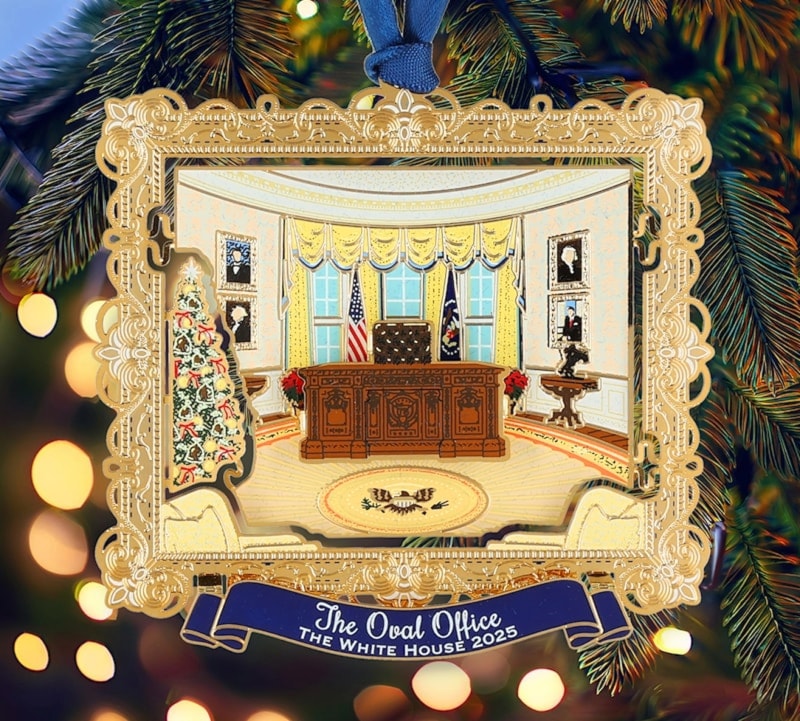
This year's 2025 White House Heritage Collection ornament captures the Oval Office in 24k gold-finished brass. The Resolute Desk sits at the center. A Christmas tree and the iconic table are physically mounted above the rest of the ornament, casting real shadows. The banner at the bottom is raised above the frame. Every detail was made to be noticed — and to last.
It is the kind of ornament that does not just hang on a tree. It starts a conversation. And now you know exactly what to say.
See the 2025 Oval Office ornament here.