The First Colony Without a King.
On June 15, 1776, New Hampshire's General Court met in Exeter and instructed its delegates to join with the other colonies "in Declaring the Thirteen United Colonies, a free and Independent State." But by that date, New Hampshire had already done something no other colony had done. It had written its own constitution.
On January 5, 1776, six months before the Declaration of Independence, New Hampshire had adopted a new framework of government with no mention of the king, no acknowledgment of royal authority, and no reference to Parliament. It was the first independent constitution of any American colony.
By June 15, 1776, the question of independence in New Hampshire had already been answered. The only thing left was to tell the rest of the colonies.
The Fort William and Mary Raid
New Hampshire's Revolution started early, four months before Lexington and Concord. On December 14, 1774, hundreds of New Hampshire colonists led by John Langdon and John Sullivan stormed Fort William and Mary at the mouth of the Piscataqua River and seized the British munitions stored there.
Paul Revere had ridden north from Boston two days earlier to warn them that British troops were about to be sent to reinforce the fort. The colonists moved first. They overpowered the small British garrison, hauled away about a hundred barrels of gunpowder and muskets, and hid them in towns throughout the region.
That raid in December 1774 is sometimes called the first armed confrontation of the Revolutionary War. Much of the powder seized at Fort William and Mary was later used at Bunker Hill six months later, keeping American muskets loaded while British troops attacked up the hill.
The January 1776 Constitution
When the royal governor, John Wentworth, fled the colony in August 1775, New Hampshire had no functioning government. The General Court, the colonial legislature, asked the Continental Congress for advice. Congress told them to write their own framework.
They did. A convention at Exeter produced a constitution that was adopted on January 5, 1776. It was brief, five handwritten pages, and it established a House of Representatives and a Council, with power flowing from the people of the colony rather than from any external authority.
This was a full six months before the Declaration of Independence. New Hampshire was not yet legally independent of Britain. But functionally, it was already operating as a free state. The January 5 constitution was, in retrospect, a declaration of independence in everything but name.
Josiah Bartlett and the Delegates
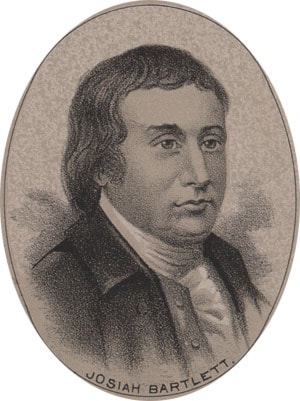
New Hampshire sent Josiah Bartlett, William Whipple, and Matthew Thornton to the Continental Congress. Bartlett, a physician from Kingston, would become the second signer of the Declaration of Independence, right after John Hancock. Because the colonies were called in a geographic order starting from the north, Bartlett was first in line after the President.
On July 2, 1776, when the Continental Congress voted on Richard Henry Lee's resolution for independence, Bartlett cast the first "yea" vote. When the Declaration was engrossed for signing on August 2, he signed it right after Hancock's famous signature.
Matthew Thornton, who arrived in Philadelphia later, became one of the last to sign, in November 1776, long after the others. But Thornton's late signature carried the same weight, because by then the document had been read aloud in town squares from Portsmouth to Savannah.
The Granite State
New Hampshire's nickname, the Granite State, hints at the colony's personality. Hard and slow to change, but decisive once it moved. New Hampshire did not spend the spring of 1776 debating independence. It had already made up its mind. On June 15, it simply confirmed what everyone already knew.
We commemorate New Hampshire on our 50 State Heritage Collection ornament.