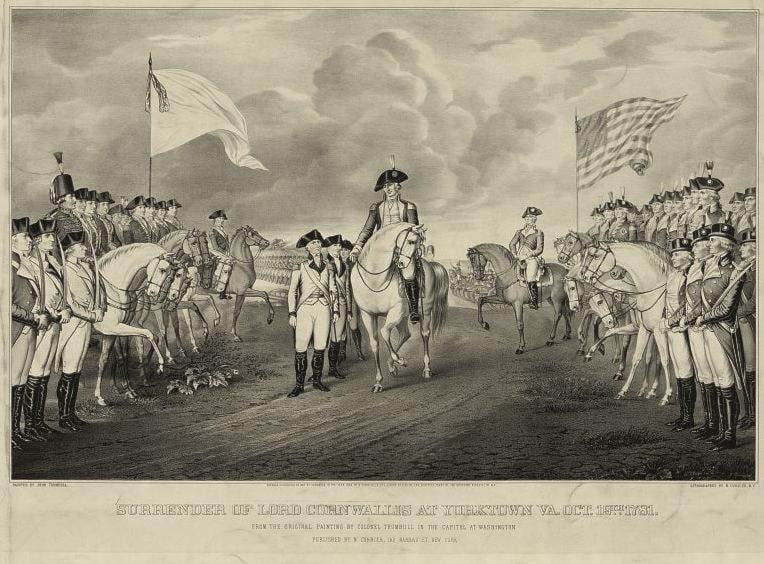
On October 19, 1781, at Yorktown, Virginia, the British general Lord Cornwallis surrendered his army of more than 7,000 men to George Washington and his French allies. It was the last major battle of the American Revolution, and it convinced Britain that it could not win the war.
Cornwallis had dug in at Yorktown, a small tobacco port on the York River, expecting the Royal Navy to supply or rescue him. Instead a French fleet under the Comte de Grasse closed the mouth of the Chesapeake Bay. Washington and the French general the Comte de Rochambeau marched their armies south from New York and surrounded the town. For weeks they pounded it with artillery. On October 17, Cornwallis wrote to Washington asking to talk terms.
The Articles of Capitulation were signed on the morning of the 19th. Washington signed for the combined forces, Rochambeau for the French army, and the Comte de Barras for the French navy. Cornwallis's soldiers became prisoners of war, and his officers were allowed to keep their swords.
At two o'clock that afternoon, the British and German troops marched out with their flags rolled up and laid down their arms between two lines, Americans on one side and French on the other. Cornwallis stayed behind, saying he was ill. He sent Brigadier General Charles O'Hara in his place. Washington directed O'Hara to his own second-in-command, Major General Benjamin Lincoln, who accepted the surrender.
That same day Washington wrote to Congress: "I have the Honor to inform Congress, that a Reduction of the British Army under the Command of Lord Cornwallis, is most happily effected."
The war didn't end overnight. The peace treaty wasn't signed in Paris until September 3, 1783. But after Yorktown, Britain stopped trying to win the war on American soil, and independence was secure.
Our 2026 White House Heritage Collection Ornament for the 250th Anniversary honors the generation that won that independence.