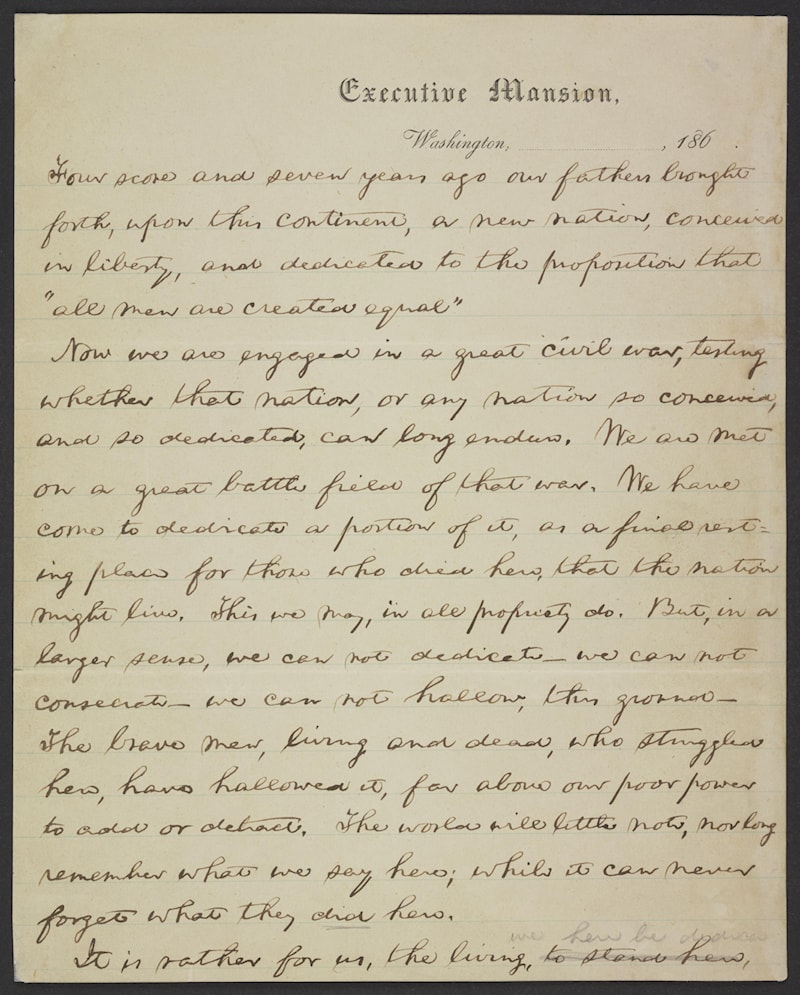
On November 18, 1863, Abraham Lincoln left the White House for Gettysburg, Pennsylvania, with a speech he had not finished and a sick boy at home. The next afternoon, 163 years ago today, he gave the Gettysburg Address.
That July, the Union and Confederate armies had fought for three days around Gettysburg, a small town in southern Pennsylvania, and thousands of soldiers died. By fall the Union dead were being reburied in a new soldiers' cemetery on the edge of town. David Wills, the local lawyer leading the effort, planned a dedication for November 19. Edward Everett, the most celebrated speaker in the country, would give the main address. Wills asked the President to follow him with "a few appropriate remarks."
People still say Lincoln wrote those remarks on the back of an envelope during the train ride. He didn't. The oldest surviving draft, now at the Library of Congress, begins on White House stationery printed "Executive Mansion." That is the page at the top of this post, and it shows Lincoln started writing at his desk in Washington. The second page is in pencil on different paper, likely a sign he was still working on the ending when he left.
He was leaving at a hard time. Ten-year-old Tad was sick with a fever, and Mary Lincoln was beside herself. Typhoid had killed their son Willie at the White House the year before.
Lincoln's train reached Gettysburg that evening, and he spent the night at the Wills home on the town square. After supper a telegram arrived from Edwin Stanton, the Secretary of War. Most of it was army news from Tennessee. The last line was about home: "By enquiry Mrs Lincoln informs me that your son is better this evening."
The next day Everett spoke for two hours. Then Lincoln stood and spoke for about two minutes, in fewer than 300 words. He began with "Four score and seven years ago" and ended with the hope that "government of the people, by the people, for the people, shall not perish from the earth."
Everett knew what he had heard. "I should be glad, if I could flatter myself that I came as near to the central idea of the occasion, in two hours, as you did in two minutes," he wrote to Lincoln the following day. Lincoln answered from the White House that same day, and he closed with news a worried father could finally share: "Our sick boy, for whom you kindly inquire, we hope is past the worst."
Five copies of the speech in Lincoln's hand survive. The last, written in March 1864, went into a book sold to raise money for the Union cause. It is the only copy he signed and dated, and it is called the Bliss copy, after Col. Alexander Bliss, who published the book. In 1949 Oscar Cintas, a former Cuban ambassador to Washington, bought it at auction. When he died in 1957, he left it to the people of the United States, to be kept at the White House.
So the speech that began on Executive Mansion paper came home. The Bliss copy is kept today in the Lincoln Bedroom, the room Lincoln used as his office. It took his name in 1945, when President Harry S. Truman furnished it with Lincoln-era pieces.
Those same words are carved into the south wall of the Lincoln Memorial. Our Lincoln Memorial ornament, from the National Treasures Heritage Collection, shows the memorial's columned front. Look between the columns and you'll find Lincoln seated inside. It is solid brass with a rhodium silver finish, made in America, and comes in a gift box with a pamphlet on the memorial's history. Have a look.