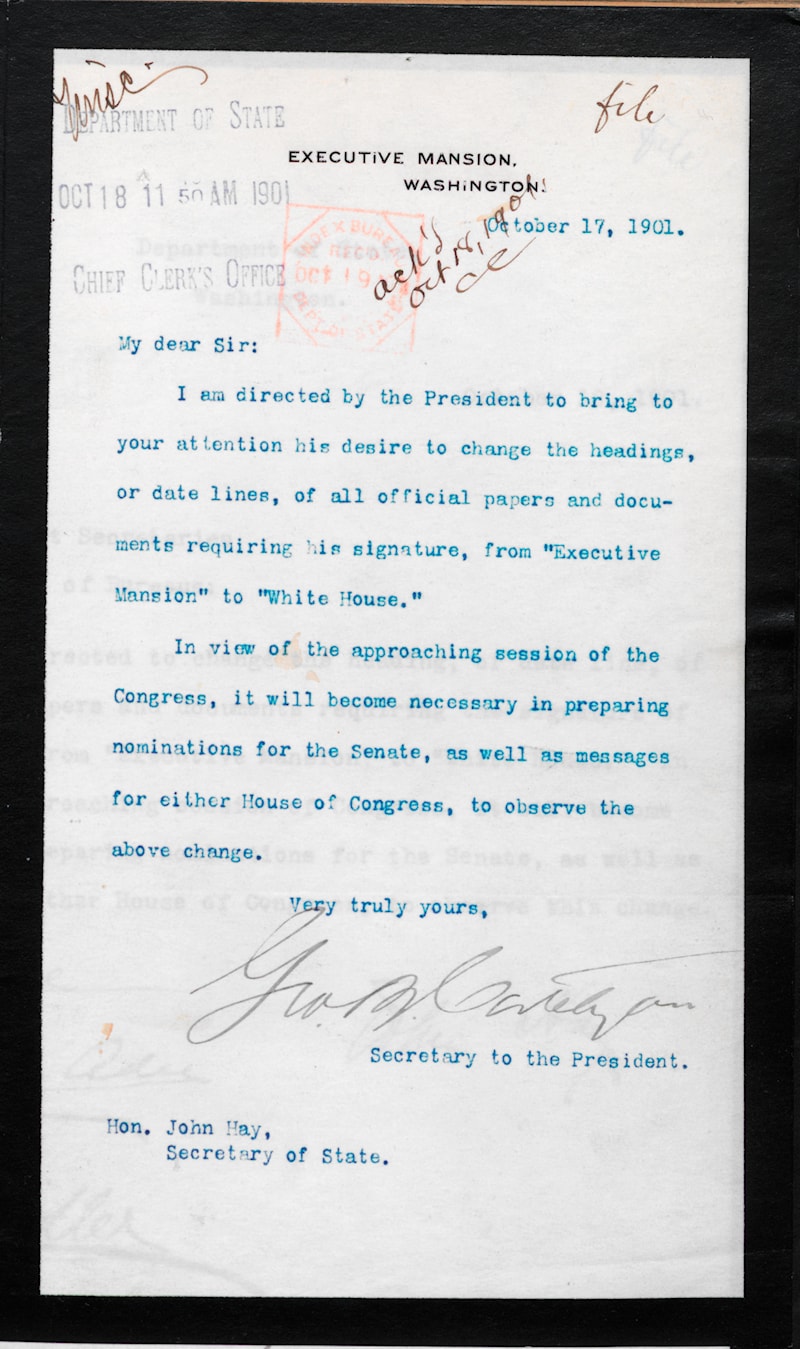
On October 17, 1901, a one-page letter went from the President's House in Washington to the State Department. It was typed on stationery printed "Executive Mansion." It asked that the President's official papers stop using that name and say "White House" instead. That letter is why the building has carried that official name for 125 years.
Theodore Roosevelt had been president for barely a month. President William McKinley was shot in Buffalo, New York, on September 6 and died on September 14. That afternoon Roosevelt, 42, took the oath of office in a friend's house in Buffalo.
The letter came from George B. Cortelyou, secretary to the President. He had held the same job under McKinley, and Roosevelt kept him on. He wrote to Secretary of State John Hay, who knew the house well. Forty years earlier Hay had lived and worked there as one of Abraham Lincoln's young secretaries.
"I am directed by the President to bring to your attention his desire to change the headings, or date lines, of all official papers and documents requiring his signature, from 'Executive Mansion' to 'White House,'" Cortelyou wrote. Congress would meet again soon, he explained, and the nominations and messages the President sent it should carry the new name.
The name itself wasn't new. The sandstone walls had been whitewashed since the 1790s, and people had called the place the White House for most of a century. Roosevelt made it official. By November 1, his letterhead read "White House." The letter to Hay survives in the National Archives, and it's the one shown here, with "Executive Mansion" still printed across the top.
The White House Historical Association's 2011 ornament honors the Roosevelt years in the house. Its front comes from a 1901 cartoon of Santa bringing gifts to the White House, with the line "I hear that there are some kids in the White House this year." We carry the 2011 White House Historical Association Theodore Roosevelt Ornament here.