New York Was the Last Colony to Say Yes.
On July 2, 1776, when the Continental Congress voted on the Lee Resolution for independence, twelve colonies voted yes. One abstained. That one was New York.
The New York delegates in Philadelphia wanted to vote for independence. They just could not. Their instructions from the New York Provincial Congress, issued months earlier, explicitly prohibited them from voting on any question of separation from Britain. So on July 2, and again on July 4 when the Declaration itself was approved, New York's delegates sat in silence while the rest of the room voted aye.
The New York Provincial Congress was supposed to have met earlier to revise those instructions. But on June 30, British warships had appeared off Staten Island. By mid-July, 130 British ships and 30,000 troops had assembled in New York harbor. The Provincial Congress was scrambling to evacuate civilians and mobilize militia. Voting on independence had moved down the priority list.
On July 9, 1776, the New York Provincial Congress finally met in White Plains, about 25 miles north of Manhattan, and unanimously authorized its delegates to endorse the Declaration. New York became the thirteenth and last colony to vote yes. The Continental Congress could now claim a unanimous decision.
The Statue on Bowling Green
That same evening, a copy of the Declaration was read aloud on the Commons in lower Manhattan to about four brigades of the Continental Army. George Washington had ordered the reading. Several thousand soldiers and civilians listened.
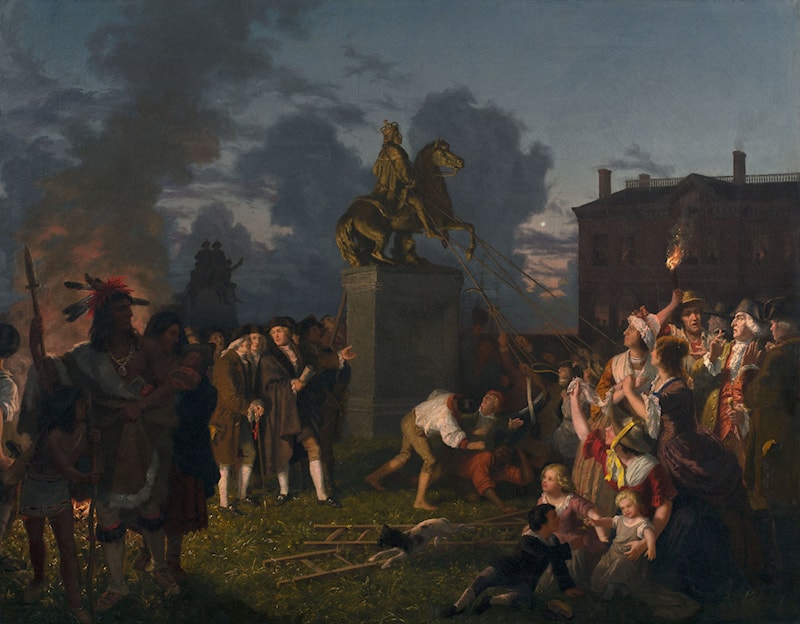
When the reading ended, the crowd moved south to Bowling Green. In the center of the park stood a two-ton gilded lead statue of King George III on horseback, mounted on a marble pedestal fifteen feet high. The statue had been installed in 1770 to celebrate the repeal of the Stamp Act, paid for by grateful New York merchants.
On the night of July 9, 1776, the crowd pulled it down. They sawed off the gilded lead, melted most of it down, and recast it into musket balls. An estimated 42,000 bullets were made from the body of King George III. Those bullets were fired at British troops later that summer and fall during the New York campaign.
A few fragments of the statue survived. Some were recovered from a swamp in Wilton, Connecticut, where Loyalists had hidden them. The horse's tail is now in the collection of the New-York Historical Society. The head was briefly taken to a tavern as a trophy and is now lost.
Why New York Was Different
New York was the hardest colony to bring into the Revolution for reasons that had little to do with ideology. It was a commercial colony, dominated by the New York City merchant class, with deep trading ties across the Atlantic and into the Caribbean. Many of its leading families were Dutch in origin, with a political culture focused on property and contracts rather than English liberties.
New York was also the most religiously and ethnically mixed of the thirteen colonies. Dutch Reformed, Anglican, Lutheran, Quaker, Jewish, and Huguenot communities all had significant presences. No single religious or cultural bloc dominated the way Puritans dominated New England or Anglicans dominated Virginia. That made political consensus slower to build.
And then there was the Hudson Valley. The great manor lords of the Hudson, the Livingstons and Philipses and Van Rensselaers, controlled enormous estates worked by tenant farmers. Many of those tenants were deeply loyal to the British crown precisely because they suspected that American independence would mean permanent rule by the manor lords. For those tenants, King George was the only authority that stood between them and their landlords.
The New York Delegation
New York sent four delegates who ultimately signed the Declaration: William Floyd, Philip Livingston, Francis Lewis, and Lewis Morris. All four would pay a price for it.
Floyd's estate on Long Island was occupied by British troops within three months of the signing, his livestock confiscated, his fields used as a cavalry camp. Livingston was forced to flee his home and died of illness in 1778 while serving in the Continental Congress, never having returned to New York. Francis Lewis had his home on Long Island destroyed by the British and his wife imprisoned for months in conditions that broke her health. Lewis Morris returned to find his estate in Morrisania burned to the ground and his forests cleared for British firewood.
The signers from every colony paid in different ways. But New York's delegates paid with the actual, physical destruction of their homes and families. The British army was in New York within weeks of the signing, and it did not leave until 1783.
The Empire State
New York's nickname is the Empire State. The phrase is sometimes attributed to George Washington, who reportedly described New York as the seat of an empire, though the evidence for the attribution is thin. What is clear is that by the early 1800s, New York had become exactly that. The state that had been the last to vote for independence became the wealthiest and most commercially powerful state in the Union by 1820.
Nothing about July 9, 1776 predicted that outcome. On that day, New York was occupied and outnumbered, with British sails on the horizon and a British army assembling on Staten Island. Its delegates in Philadelphia had just finally been allowed to say yes, weeks after everyone else. And as the sun set over Manhattan, a crowd was melting down a statue of the king into musket balls.
We commemorate New York on our 50 State Heritage Collection ornament.